Walking in NYC: The Best Walks, Trails & Neighborhood Routes
Walking in NYC is the primary way New Yorkers move through the city, and the most rewarding way for visitors to experience it. The Manhattan grid is famously easy to follow (20 blocks per mile north-to-south, 4–5 blocks per mile east-to-west), and NYC’s WalkScore is 88 out of 100 — the highest of any major U.S. city. The best walks in NYC include the Brooklyn Bridge (1.1 miles), the High Line (1.45 miles), Central Park’s loops (1.6 miles at the Reservoir to 6+ miles around the full drive), Fifth Avenue from Central Park to Washington Square, the Hudson River Greenway (11 miles), and dozens of neighborhood-specific routes across Brooklyn, Queens, and the Bronx.
I’ve walked NYC for years — through every neighborhood in Manhattan, most of Brooklyn, big chunks of Queens, and up to the Grand Concourse in the Bronx. I’ve walked at 5 a.m. for the empty streets and at 2 a.m. after a Broadway show. I’ve walked in blizzards, hurricanes, and 98°F heat waves. Experiencing NYC Walkability firsthand has taught me that walking in the city is a specific skill — pace matters, awareness matters, and shoe choice matters. Most guides to walking in NYC treat it like a tourist checklist. This one is written from years of actually moving through the city on foot.
You’ll find every angle on walking in NYC: the honest safety picture, how fast New Yorkers actually walk, best shoes for every season, the best walking routes across all five boroughs, guided walking tours (free and paid) with real recommendations, self-guided itineraries with specific timing, urban hiking options that don’t require a car, dog walking rules and rates, a Whisper Corners section on local moves, and a long FAQ covering everything from “is Manhattan walkable” to “best shoes for walking in NYC winter” to “hiking in NYC without a car.”
Is NYC Walkable? The Direct Answer
Yes — NYC is one of the most walkable cities in the United States, and Manhattan specifically is one of the most walkable places in the world. WalkScore rates NYC at 88 out of 100, ahead of San Francisco (87) and Boston (83). Manhattan alone rates 89. Brooklyn is 80. Queens and the Bronx are less pedestrian-dominant but still walkable in specific neighborhoods.

Why NYC is walkable:
- Grid street system in most of Manhattan and much of Brooklyn/Queens (predictable, easy to follow on foot)
- High density of destinations (restaurants, shops, subway stations, parks) within short walking distance
- Extensive sidewalk infrastructure
- Pedestrian-focused areas (Times Square pedestrian plazas, Herald Square, parts of Broadway)
- Public parks along walking corridors (Central Park, Prospect Park, Hudson River Greenway, Brooklyn Bridge Park)
- 24/7 activity on streets in most Manhattan neighborhoods (safer walking at odd hours)
How walking distances work in NYC:
- 20 blocks = 1 mile north-to-south in Manhattan (each block is roughly 264 feet)
- 4–5 blocks = 1 mile east-to-west (each avenue block is roughly 900 feet — much longer)
- Cross-town walking (east-west) takes significantly longer than uptown-downtown walking
- Times Square to Battery Park (~4 miles): 75–90 minute walk
- 42nd Street to 96th Street (~2.7 miles): 55–65 minute walk
Where NYC gets less walkable:
- Outer parts of Queens (Rockaway, Bayside) — car-focused
- Southern Brooklyn (Mill Basin, Marine Park)
- Parts of the Bronx (Riverdale, Throggs Neck)
- Staten Island (most of it)
- Any elevated highway zones (near the Belt Parkway, Long Island Expressway)
The Basics: Walking in NYC Like a New Yorker
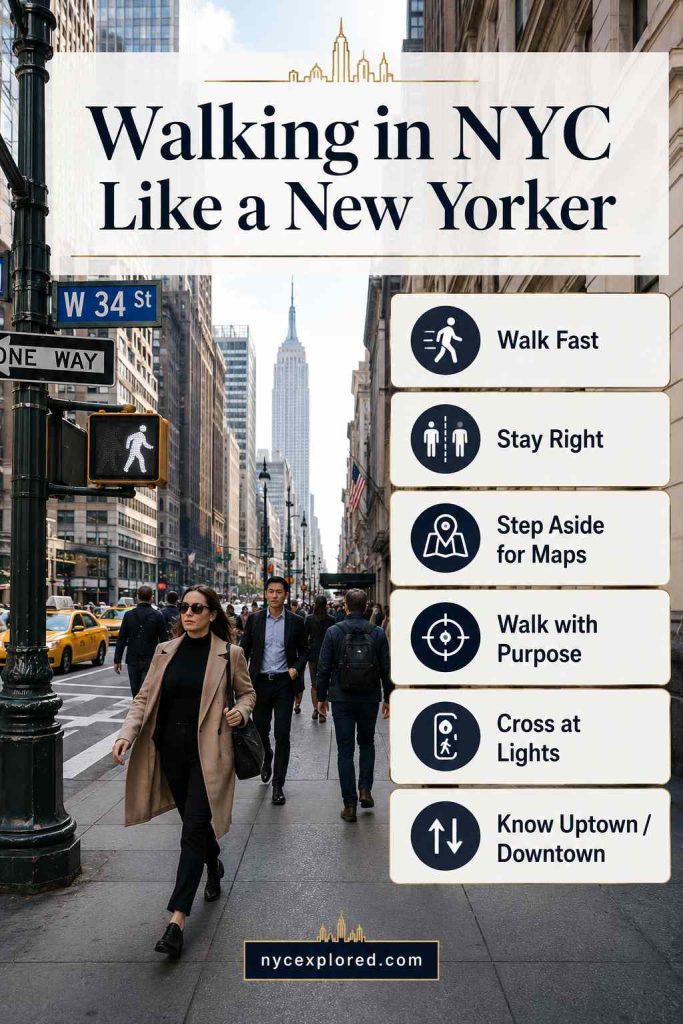
New Yorkers have specific expectations about pedestrian behavior. Following them makes walking in NYC easier and marks you as someone who knows the city.
Do New Yorkers Walk Fast?
Yes. NYC walkability is one of the reasons New Yorkers move so quickly. The average New Yorker walks at 3.5–4 mph — roughly one block every 15–20 seconds in Manhattan. This is significantly faster than most American cities. Walking slowly on a Midtown sidewalk during business hours will earn irritated glances.
The etiquette:
- Walk on the right on sidewalks. This isn’t a rule but it’s a strong convention.
- Don’t stop suddenly to check your phone or map. Step to the side of the sidewalk first.
- Walk in single file with your group during rush hour. Blocking the sidewalk is one of the biggest NYC pedestrian sins.
- Follow “New York style” crosswalk timing — locals cross when the coast is clear, even against a red light. Don’t feel obligated to wait if there’s no traffic, but be aware.
- Don’t look up at buildings while walking in Midtown. Locals will bump you. Look up when you’ve stepped to the side.
- Umbrellas held low to avoid poking people.
How to Walk in New York City
Practical basics:
- Get an OMNY-compatible phone or card so you can hop on the subway when you need to skip a longer walk.
- Know which direction is uptown / downtown / east / west. Manhattan’s numbered streets make this easy — higher numbers = north.
- Walk with purpose. Even if you’re lost, walking confidently while checking your phone at a coffee shop stop is safer than looking lost in the middle of the sidewalk.
- Cross avenues at traffic lights. Crossing a wide avenue mid-block is genuinely dangerous.
- Use Google Maps or Citymapper for step-by-step walking directions. Both are accurate for NYC.
How to Walk Around Manhattan
Manhattan-specific walking approach:
- Get around by cross-streets. “Meet me at 5th and 42nd” is standard. Give addresses as intersections.
- East-west walking takes longer than north-south. A 10-block avenue walk feels like 20 numbered-street blocks.
- Diagonal shortcuts: Broadway cuts diagonally across the grid from Battery to the Bronx. Using it saves time.
- Named streets: In Lower Manhattan (below Houston), the grid breaks and streets have names — Broome, Grand, Canal, etc. Use maps here.
Is It Safe to Walk in NYC?
Yes, walking in NYC is generally safe. NYC Walkability is one of the city’s greatest strengths, especially in Manhattan, where high foot traffic, extensive street lighting, and a consistent police presence make walking a practical and comfortable way to get around. That said, standard urban awareness matters, and safety varies by neighborhood, time of day, and specific circumstances.

Is it safe to walk in Manhattan? Yes, walking in Manhattan is safe in most neighborhoods most of the time. Midtown, Chelsea, the Village, the Upper East and West Sides, and the Financial District are safe day and night. Standard precautions:
- Keep valuables secure and phones in inside pockets
- Be aware of surroundings, especially when using your phone
- Trust your instincts — if a block feels off, cross to the other side
- Avoid isolated areas late at night (deserted commercial districts, some parts of empty parks)
Safer walking hours: 6am–10pm in most Manhattan neighborhoods. After 10pm, more populated commercial streets (Broadway, 5th, 3rd, 2nd Avenues, MacDougal, Bleecker) stay busy and safe. Empty side streets in commercial districts (Financial District at 3am, Garment District at midnight) become quieter.
Reasonable-caution neighborhoods: Some parts of the outer Bronx, deep Brooklyn, and outer Queens have higher street crime rates. Check specific neighborhoods before extensive walking there.
Walking in NYC as a woman: Generally safe with the same standard urban awareness that applies anywhere. The “10 hours of walking in NYC as a woman” viral videos from years past showed unwanted verbal attention, which does happen — mostly harassment rather than criminal activity, but real and unpleasant. Most women who live and walk in NYC do so daily without incident, and NYC Walkability makes it easy to stay on busy, well-traveled streets. Trust your instincts, use populated routes, and avoid isolated areas at night.
Best Shoes for Walking in NYC
Shoe choice matters more in NYC than in most cities because you’ll walk 5–15 miles on some days. My honest picks:

Spring / Fall (60–75°F):
- Athletic sneakers (New Balance, Nike, Adidas) — best all-around comfort
- Waterproof leather boots for shoulder-season rain
- Avoid new shoes without breaking in first
Summer (75–95°F):
- Breathable athletic sneakers
- Sandals or leather slides for shorter distances (not for 8-mile days)
- Avoid heels (concrete kills them fast)
Winter (25–45°F): Best shoes for walking in NYC winter are waterproof, insulated, and gripped. Options:
- Sorel Caribou boots — waterproof, warm, good grip on ice
- Vasque Coldspark — hiking-style winter boot
- Blundstone or Chelsea boots — waterproof if treated; not for extreme cold or ice
- Snow boots specifically — Bogs, LL Bean, Kamik
- Avoid Uggs — they’re not waterproof and get destroyed by NYC winter salt
Everyday commuter option: A pair of good athletic sneakers plus a pair of waterproof shoes cover most NYC weather conditions. Keep a pair at the office if you commute in nice shoes.
Weather and Seasons for Walking in NYC

- Spring (March–May): Best walking season. 45–70°F most days. Occasional rain. Perfect for exploring.
- Summer (June–August): Hot (75–95°F) and humid. Walking during peak sun (11am–4pm) is uncomfortable. Best walking in early morning (6–10am) or evening (7–10pm). Bring water.
- Fall (September–November): Second-best walking season. 45–70°F, low humidity, spectacular light.
- Winter (December–February): Cold (25–45°F) with occasional snow. Walking possible with proper gear. Sidewalks can be icy after snow — grip matters. Post-storm walking in Central Park is magical.
- Rainy days: NYC has good rain infrastructure. Sidewalks drain, taxi options exist. Waterproof outerwear + waterproof shoes = walking normally.
Best Walking Routes in Manhattan

1. Brooklyn Bridge Walk
- Distance: 1.1 miles pedestrian span
- Time: 30–45 minutes
- Best entry: Manhattan side at City Hall Park or Brooklyn side at Cadman Plaza
The Brooklyn Bridge is one of the most iconic NYC walking routes, attracting locals and visitors alike. The new pedestrian-and-bike-lane redesign completed in 2021 improved safety. The best time to walk is at sunset for spectacular skyline views, and you’ll get the best photographs from the Brooklyn side looking back at Manhattan.

2. The High Line
- Distance: 1.45 miles
- Time: 45–60 minutes
- Entry points: Gansevoort Street (south end), 34th Street/Hudson Yards (north end)
The High Line is an elevated linear park built on former freight rail infrastructure. Piet Oudolf plantings, art installations, city views. Get there when it opens (7am) for empty photos.
3. Central Park Reservoir Loop
- Distance: 1.58 miles
- Time: 30 minutes
- Entry: 86th Street on the east or west side of Central Park
The Reservoir loop is Central Park’s flagship walking route — packed cinder path around the water, cherry blossoms in April, joggers year-round.

4. Central Park Perimeter or Drive Loop
- Distance: 6.1 miles (full perimeter drive)
- Time: 2 hours
- Entry: Any Central Park entrance
The full loop around Central Park drive (now car-free) is one of the great long walks in NYC. Passes the Great Lawn, Belvedere Castle, the Ramble, Sheep Meadow, Bethesda Fountain, the Boathouse.
5. Hudson River Greenway
- Distance: 11 miles (Battery Park to George Washington Bridge)
- Time: 4–5 hours for the full length
- Best sections: Battery to Chelsea Piers (3 miles), Chelsea to 79th Street Boat Basin (4 miles)
The Hudson River Greenway runs the entire west side of Manhattan. Bike-and-walk path with river views. Best afternoon walk in NYC on a clear day.

6. Battery Park to Financial District Loop
- Distance: 2–3 miles depending on route
- Time: 1–1.5 hours
Battery Park, Wall Street, One World Trade Center, Fulton Center, South Street Seaport. Dense historic architecture — much of NYC’s oldest built environment.
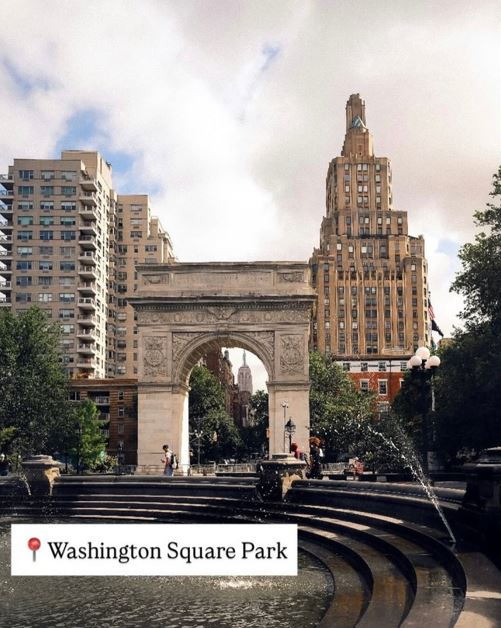
7. Fifth Avenue Walk (Central Park to Washington Square)
- Distance: 2.7 miles
- Time: 55–65 minutes
- Best entry: Grand Army Plaza (59th and 5th) or Washington Square
Fifth Avenue walking route passes the Metropolitan Museum, the Empire State Building, Herald Square, and ends at Washington Square Park. High energy urban walking.
8. Greenwich Village Walk
- Distance: 2–3 miles (self-guided)
- Time: 1.5–2 hours
Wander MacDougal Street, Bleecker Street, Christopher Street, Washington Square, 6th Avenue. Passes the Stonewall Uprising monument, the LGBT Community Center, historic townhouses. This is walking NYC at its most literary.
Best Walking Routes in Brooklyn NYC

1. Brooklyn Bridge Park + Brooklyn Heights Promenade
- Distance: 2–3 miles
- Time: 1.5 hours
Enter at Brooklyn Bridge Park piers, walk north through the park past Jane’s Carousel and DUMBO, cross up to the Brooklyn Heights Promenade for the classic Manhattan skyline view.
2. Williamsburg Waterfront + Williamsburg Bridge
- Distance: 3 miles
- Time: 1.5–2 hours
Walk south along the Williamsburg waterfront (Domino Park, Marsha P. Johnson State Park), then cross the Williamsburg Bridge into the Lower East Side. This is one of the most scenic NYC walking routes, perfect for combining a Brooklyn morning with a Manhattan afternoon.

3. Park Slope + Prospect Park
- Distance: 3.5 miles (full Prospect Park loop is 3.35 miles)
- Time: 1.5–2 hours
Prospect Park is Central Park’s Brooklyn counterpart — 526 acres, less crowded than Central Park. Long Meadow is one of the best walking landscapes in NYC.
4. DUMBO Walking Loop
- Distance: 1.5–2 miles
- Time: 1 hour
Bridge Street to Jay Street, Front Street, Water Street, back to DUMBO Landing. Cobblestone streets, historic industrial buildings, Empire Fulton Ferry, Jane’s Carousel.
Best Walking Routes in Queens and the Bronx

Queens: Astoria to Long Island City Waterfront
- Distance: 3–4 miles
- Time: 1.5–2 hours
Walk from Astoria Park south along the East River waterfront past Socrates Sculpture Park, into Long Island City to Gantry Plaza State Park. One of the underrated skyline walks in NYC.
Queens: Flushing Meadows Corona Park
- Distance: 2–4 miles depending on route
- Time: 1–2 hours
Park itself is 897 acres. Unisphere, Queens Museum, Citi Field access.

Bronx: Grand Concourse
- Distance: 4.5 miles (Yankee Stadium area to Fordham Road)
- Time: 2 hours
The Grand Concourse is the Bronx’s Fifth Avenue — 1909 Art Deco boulevard designed as a Bronx counterpart to the Champs-Élysées. Past Yankee Stadium (home of Joe DiMaggio history), the historic Concourse Plaza Hotel, and up to the Bronx Museum. Underrated urban architectural walk.
Bronx: Arthur Avenue + Bronx Little Italy
- Distance: 1–2 miles
- Time: 1 hour + food breaks
Arthur Avenue in the Belmont section of the Bronx is genuinely one of NYC’s best Italian-American food districts. Walking tour with market visits, pasta shops, and butcher stops.
Guided Walking Tours in NYC
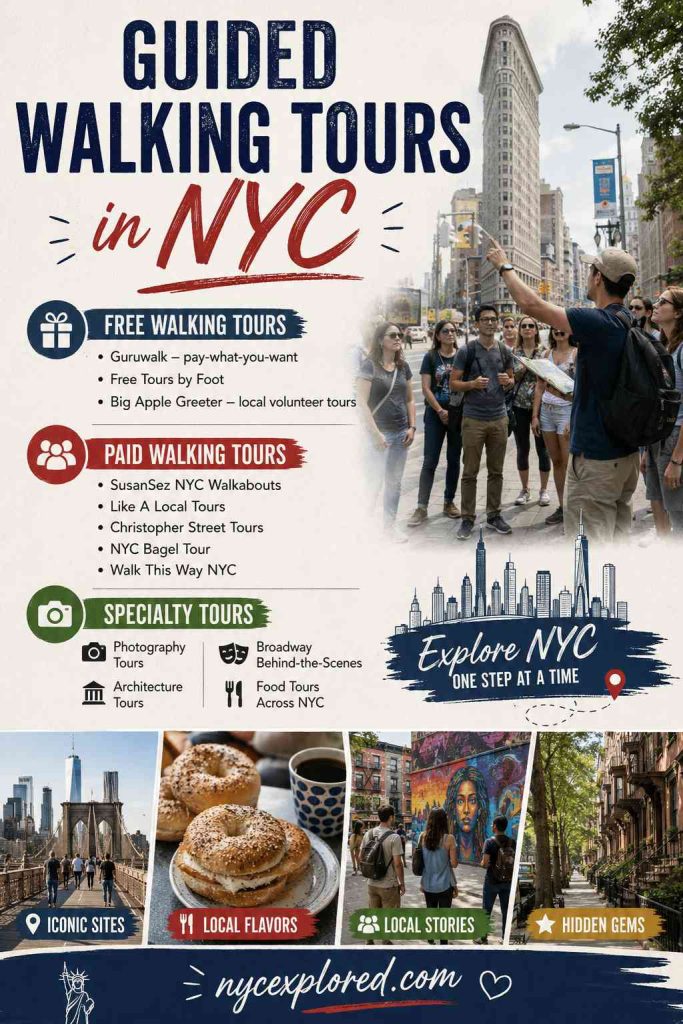
Guided walking tours in NYC range from free volunteer-led tours to $100+ specialty experiences. NYC Tourism publishes a curated list of recommended operators; the picks below cover the range.
Free Walking Tours
- Guruwalk — pay-what-you-want tours, many led by volunteer local guides. Multiple daily options.
- Free Tours by Foot — free/tip-based, well-organized routes.
- Big Apple Greeter — volunteer program pairing visitors with local New Yorkers for free personalized walking tours.
Paid Walking Tours
- SusanSez NYC Walkabouts — Susan Birnbaum’s specialty tours including the Seneca Village Tour, which explores the pre–Civil War Central Park land that was once a Black community.
- Like A Local Tours — cultural and food-focused tours across NYC boroughs. Their Sustainable Brooklyn Food & Fashion Tour visits Williamsburg spots including Artist & Fleas, Awoke Vintage, Tacombi, and Black Brick.
- Christopher Street Tours — LGBTQ history-focused tours including the Village Pride Walking Tour covering the Stonewall Uprising, the LGBT Community Center, and West Village queer history.
- NYC Bagel Tour — the tour explores multiple bagel shops across Chelsea, Times Square, and the Brooklyn-based Bagel Crafting tour with expert-led bagel tastings at spots like Tal Bagels UWS.
- Walk This Way NYC — private and small-group walking tours across Manhattan.
Specialty Walking Tours
- Photography walking tours — led by street photographers through Chinatown, Lower East Side, Brooklyn. Reference the Edward Steichen photography legacy of the Flatiron Building era.
- Architecture walking tours — led by the Municipal Art Society.
- Broadway theater district tours — behind-the-scenes tours of theaters.
- Food walking tours — Chinatown eats, Little Italy pasta stops, Brooklyn bagel routes.
Self-Guided Walking NYC Itineraries

Half-Day Manhattan Walk (4 hours)
Start: Battery Park (9am) Route: Battery → Wall Street → Fulton Street → Brooklyn Bridge → back → City Hall → SoHo → Washington Square → Village Total distance: 5 miles Best days: Weekday morning; avoid Saturday afternoon crowds
Full-Day Manhattan Walk (7–8 hours)
Start: Central Park (10am) Route: Central Park south exit → Fifth Avenue → Rockefeller Center → Times Square → Chelsea (via 42nd) → High Line → Meatpacking → Washington Square → Village → SoHo Total distance: 8 miles Best day: Weekday spring/fall
Full-Day Brooklyn Walk (6 hours)
Start: DUMBO ferry landing (10am) Route: DUMBO → Brooklyn Heights Promenade → Cadman Plaza → Brooklyn Bridge (walk to Manhattan and back) → Fulton Ferry → Empire Stores → Vinegar Hill → Navy Yard perimeter → Fort Greene → BAM area Total distance: 6 miles Best day: Weekend afternoon (Fort Greene comes alive)
Urban Hiking in New York City
Beyond city walking, NYC has genuinely good urban hiking options — nature walks that don’t require leaving the five boroughs or renting a car.
Hiking in NYC Parks
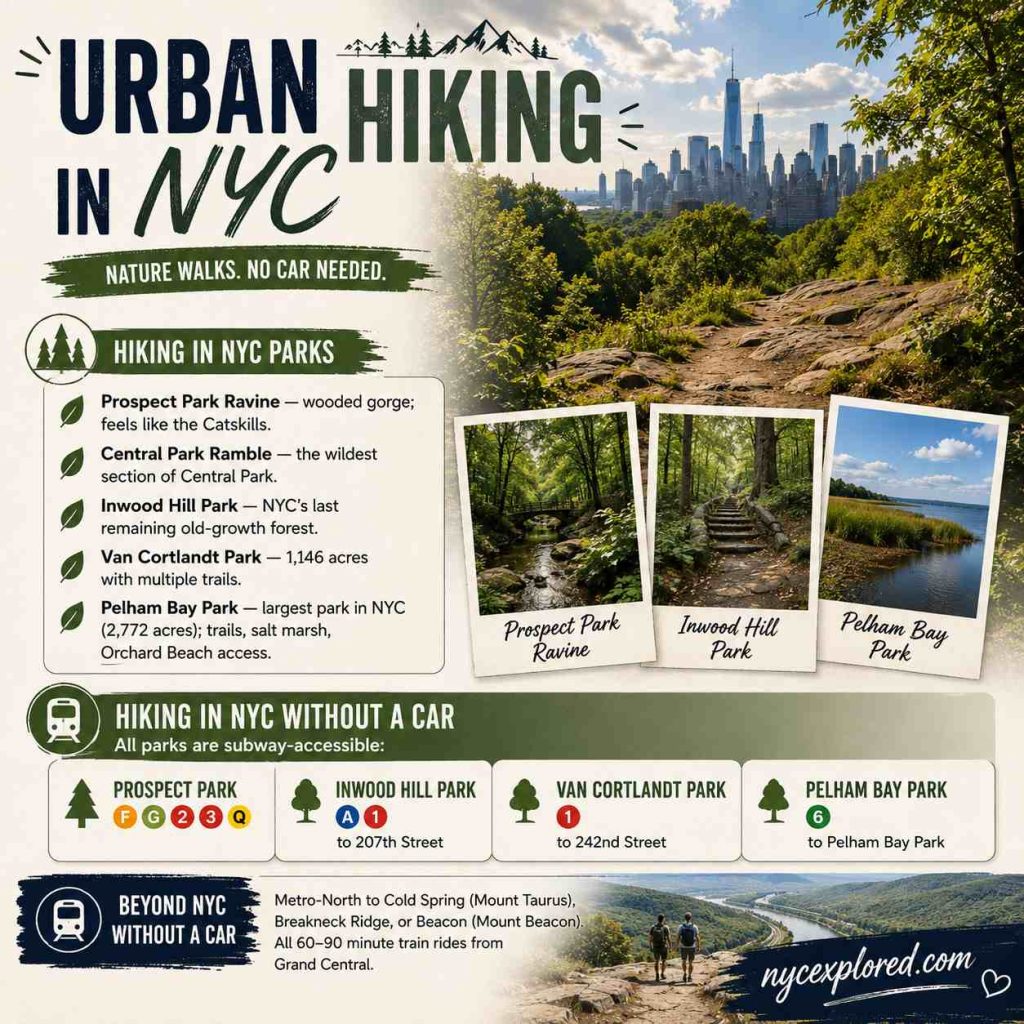
- Prospect Park Ravine — the wooded gorge in Prospect Park’s center. Feels like the Catskills.
- Central Park Ramble — the wildest section of Central Park.
- Inwood Hill Park — northern tip of Manhattan; has NYC’s last remaining old-growth forest.
- Van Cortlandt Park — 1,146 acres in the Bronx; multiple trails.
- Pelham Bay Park — largest park in NYC (2,772 acres); trails, salt marsh, Orchard Beach access.
Hiking in NYC Without a Car
All of the above are subway-accessible:
- Prospect Park (F/G, 2/3, Q)
- Inwood Hill Park (A/1 to 207th Street)
- Van Cortlandt Park (1 to 242nd Street)
- Pelham Bay Park (6 to Pelham Bay Park)
For hiking beyond city limits without a car: Metro-North to Cold Spring (Mount Taurus), Breakneck Ridge, or Beacon (Mount Beacon). All 60–90 minute train rides from Grand Central.
Dog Walking in NYC
For NYC residents: dog walking in NYC is a serious industry.

Dog walking rates in NYC (2026):
- Solo 30-minute walk: $22–$35
- Solo 60-minute walk: $35–$50
- Group walk (30 min, 3–4 dogs): $18–$25
- Overnight care: $75–$125/night
- Monthly walker services: $400–$800/month
Rates are highest in Manhattan (especially Upper East/West Side), lower in Brooklyn and Queens.
Popular dog walking services: Wag, Rover, and local independents. Most Reddit consensus favors local walkers over apps for quality.
Dog-friendly walking areas:
- Central Park (off-leash before 9am and after 9pm in designated areas)
- Prospect Park (off-leash same hours)
- Riverside Park
- Fort Greene Park
- Brooklyn Bridge Park
The Whisper Corners: Local Moves for Walking in NYC
Real strategies for walking in NYC — the moves that make it work.
Walk Diagonally on Broadway
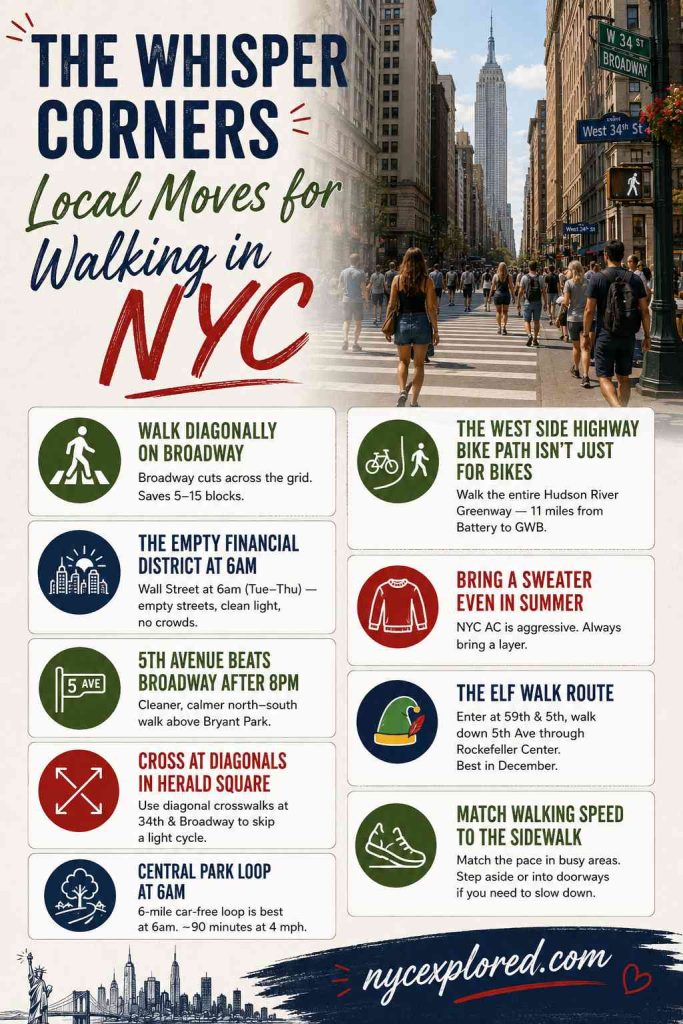
Broadway cuts across the Manhattan grid diagonally. Using it as a route saves 5–15 blocks depending on origin/destination. Times Square to Union Square via Broadway is about 20 blocks; via a straight avenue is closer to 40 avenue blocks.
The Empty Financial District at 6am
Wall Street and the Financial District at 6am on a weekday are one of the great urban walking experiences in NYC. Empty streets, clean light on the buildings, no crowds. Best done Tuesday through Thursday.
5th Avenue Beats Broadway After 8pm
Fifth Avenue’s north-south walking corridor above Bryant Park stays cleaner and less crowded at night than Broadway. If you’re walking from Midtown home to the Upper East Side, use 5th.
Cross at Diagonals in Herald Square
The pedestrian plaza at Herald Square (34th and Broadway) has diagonal crosswalks that let you skip a light cycle in the right direction.
Central Park Loop at 6am
The full 6-mile Central Park loop (now car-free) is at its best at 6am — light on the West Side buildings, few runners, no tourists. Loop takes about 90 minutes at 4 mph.
The West Side Highway Bike Path Isn’t Just for Bikes
The Hudson River Greenway technically prioritizes bikes on part of its path, but pedestrians can walk the entire 11 miles from Battery to GWB on the paved footpath. Beats walking through Midtown any day.
Bring a Sweater Even in Summer
NYC’s air conditioning is aggressive. Walking in NYC in summer requires bringing a layer for restaurants, museums, subway rides that would otherwise be too cold with sweat-damp clothes.
The Elf Walk Route
There’s a viral video called “Elf Walking in NYC” that shows a costumed guy walking from Fifth Avenue to Central Park in a way many people replicated. If you want the “Elf’s” NYC walk: enter at 59th and 5th, walk south through Rockefeller Center, past the tree in December, and down 5th Avenue. Best done in December.
Match Walking Speed to the Sidewalk
In Midtown business districts during rush hour, match the pace of the sidewalk. Walking slower forces people around you and blocks traffic. If you need to slow down, step to the side or into a doorway.
A Final Word From Someone Who Walks Every Day
Walking in NYC is one of the reasons this city works. Every day I choose walking over the subway when the distance is under 2 miles and the weather is decent. I’ve discovered restaurants, bookstores, and quiet blocks I would never have known about if I’d taken the F train instead of walked.
My honest advice for anyone walking in NYC:
- Walk more than you think you should. The best NYC discoveries happen on foot. Give yourself permission to walk 20 blocks and see what happens.
- Wear real walking shoes. Not fashion sneakers. Not new shoes. Real shoes broken in with real socks.
- Plan routes around parks. Central Park, Prospect Park, Brooklyn Bridge Park, and the Hudson River Greenway are the antidotes to concrete fatigue.
- Walk at the right times. 6–10am and 7–10pm are the best walking hours. Midday summer heat and 4–7pm Midtown rush are punishing.
- Match your pace to the crowd. Not faster (annoying), not slower (also annoying).
- Cross-town takes longer than uptown-downtown. Budget accordingly.
- When lost, walk to the nearest coffee shop and orient there. Don’t stand in the middle of the sidewalk with a map.
- Sunday morning walks are the best. Empty streets, soft light, no rush.
If you’re visiting NYC, prioritize walking. The best 4–5 hours of your trip should be spent moving through neighborhoods on foot, not shuttling between attractions. The city reveals itself at walking speed — the shop windows, the architecture, the conversations on stoops, the delivery cyclists, the light hitting the cast-iron facades in SoHo at 4pm — all of it disappears from a taxi window.
One last thing: walking in NYC in the rain is genuinely beautiful. Wet streets reflect neon. Umbrellas make the crowds feel human. The city softens. If you get caught in a rainstorm, don’t run for shelter — walk through it. That’s when NYC feels most like itself.