NYC Taxi & Rideshare Guide 2026: Fares, Uber vs Taxi, Apps & Tips
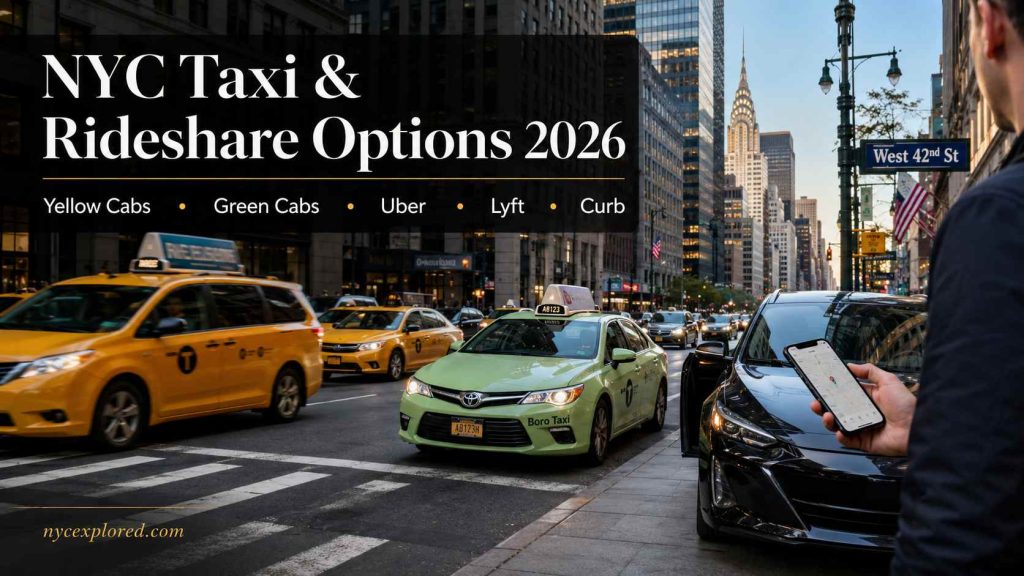
NYC taxi & rideshare options in 2026 give you five main choices for a paid ride: classic yellow cabs (Manhattan and airports), green Boro Taxis (outer boroughs and upper Manhattan above 110th Street on the West Side / 96th Street on the East Side), Uber, Lyft, and the Curb app (which e-hails licensed yellow and green taxis).
All operate under the New York City Taxi and Limousine Commission (TLC) but with different regulations, fare structures, and pickup rules. As of 2026, yellow cabs start at $3.00 on the meter; Uber and Lyft use dynamic surge pricing; and every trip in Manhattan south of 96th Street now carries multiple congestion surcharges added on top.
I’ve taken thousands of NYC taxi and rideshare trips over the last decade — yellow cabs at 3am from Newark, Ubers to Brooklyn dinners, Lyfts to LaGuardia, Curb-hailed taxis when I couldn’t be bothered to wave. I’ve watched congestion pricing get proposed, delayed, killed, revived, launched (January 5, 2025), and become part of every fare comparison. Most guides to NYC rideshare & taxi read like they were written in 2019.
This one covers what actually matters in 2026 — including the current fares, the two overlapping congestion charges (the older NY State surcharge plus the newer MTA Congestion Relief Zone toll), and honest answers to the question everyone asks: NYC taxi or Uber?
You’ll find a full breakdown of every NYC taxi and rideshare option, a cost comparison table, updated airport fare rules (JFK flat rate is still $70 pre-tolls; Newark now has a $20 surcharge; LaGuardia is metered), a Whisper Corners section with the local moves drivers use, and a long FAQ covering the questions people actually search — including whether NYC taxis do Uber, whether cabs or Uber are cheaper, and how safe rideshares actually are.
Your NYC Taxi & Rideshare Options: What’s Actually Available in 2026
The NYC taxi and rideshare landscape breaks into five clean categories.
1. Yellow Cabs (medallion taxis) — the classic yellow taxi you can hail on the street anywhere in NYC. Roughly 13,500 in operation. Only yellow cabs can pick up street hails in Manhattan south of 96th Street on the East Side and south of 110th Street on the West Side.
2. Green Cabs (Boro Taxis / Street Hail Liveries) — the light-green taxis introduced in 2013. Around 3,000 on the road. Can pick up street hails in Upper Manhattan (above 110th West Side / 96th East Side) and in the outer boroughs (Brooklyn, Queens, the Bronx, Staten Island). Cannot pick up street hails in central Manhattan.
3. Uber — largest rideshare app in NYC. Multiple service tiers (UberX, Uber Comfort, UberXL, Uber Black, Uber Pool). App-only, all TLC-licensed drivers and vehicles.
4. Lyft — second-largest rideshare, similar interface to Uber. Slightly smaller driver base, sometimes slightly cheaper.
5. Curb — an e-hail app for licensed yellow and green taxis. This is the answer to “is there a taxi app for NYC” — Curb is it. Also works to pay for rides in any Curb-equipped yellow cab even if you flagged it on the street.
Smaller alternatives that still operate include Via (now more focused on B2B mobility), Revel (electric Teslas, higher-end), Arro (another yellow taxi e-hail), and Gett (business focus). Juno shut down in 2019.
Yellow Cabs: The Classic NYC Taxi
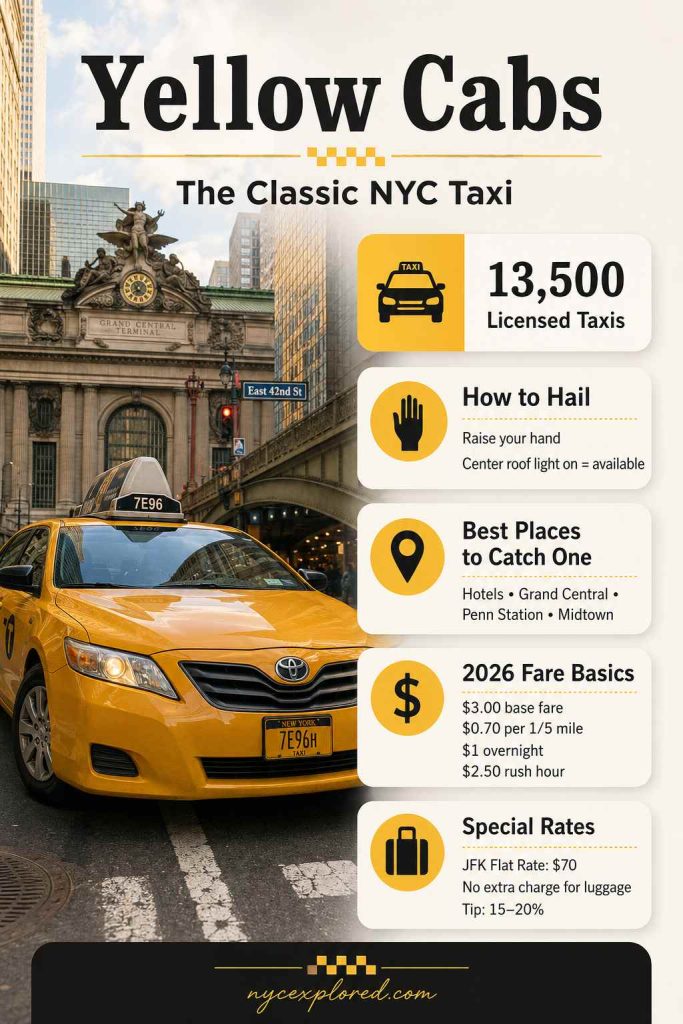
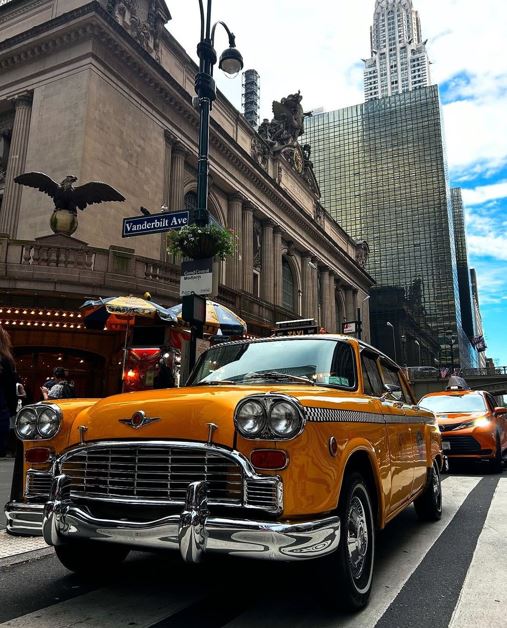
The yellow cab is the classic NYC taxi. There are about 13,500 licensed medallion yellow taxis operating today, down significantly from a peak of over 20,000 rides per hour a decade ago as rideshare took market share.
How to Hail a Yellow Cab
Stand on the curb, face traffic, raise your hand. If the center light on the roof (the medallion number) is illuminated, the cab is available. If the “off duty” side lights are on, it’s not accepting fares. If nothing is lit, it’s occupied.
The most reliable places to catch an empty yellow taxi: outside major hotels, at Grand Central Terminal, Penn Station, hospital entrances, and along Sixth or Eighth Avenue in Midtown between 5pm and 8pm (fresh shift-change).
Yellow Cab Fare Structure (2026)
Base metered fare (Rate Code 1 — Standard City Rate):
| Charge | Amount |
| Initial charge | $3.00 |
| Per 1/5 mile or per 60 seconds in slow traffic | $0.70 |
| Overnight surcharge (8pm–6am daily) | $1.00 |
| Weekday rush hour surcharge (4pm–8pm, Mon–Fri) | $2.50 |
| Improvement surcharge | $0.30 |
| NY State Congestion Surcharge (below 96th Street) | $2.50 |
| MTA Congestion Relief Zone toll (below 60th Street) | $0.75 |
| MTA state surcharge | $0.50 |
So a short cab ride from Midtown to the Village at 6pm on a weekday will have the $3.00 initial + meter + $2.50 rush hour + $2.50 congestion + $0.75 MTA toll + $0.30 + $0.50 = roughly $6.55 in surcharges on top of the meter itself.
There is no charge for extra passengers, luggage, or paying by credit card. Passengers pay all bridge and tunnel tolls. Tipping is 15–20% of the fare.
Yellow Cab Special Rates
- Rate Code 2 (JFK): Flat rate of $70 between Manhattan and John F. Kennedy International Airport (any direction), plus tolls, tips, and the $2.50 congestion surcharge if the trip crosses below 96th Street.
- Rate Code 3 (Newark): Metered fare plus $20 Newark surcharge, plus tolls both ways (passenger pays driver return tolls).
- Rate Code 4 (Westchester/Nassau): Metered fare from city limits plus 1.5x multiplier for suburbs.
- Rate Code 5 (out-of-city negotiated flat rate): Rare, must be agreed before trip.
Green Cabs: The Boro Taxi System
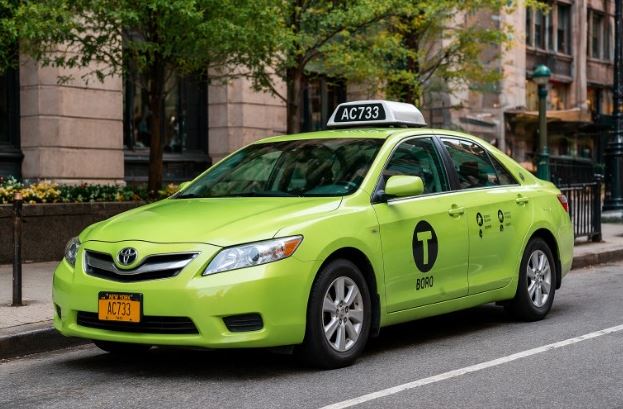
Green cabs (also called Boro Taxis or Street Hail Liveries) launched in 2013 to solve a real problem: taxis weren’t cruising the outer boroughs, so residents outside central Manhattan couldn’t hail a cab. About 3,000 green taxis operate today.
Where Green Cabs Can Pick You Up
Green cabs can street-hail passengers in these areas only:
- Upper Manhattan: North of West 110th Street on the West Side, north of East 96th Street on the East Side
- Brooklyn, Queens, the Bronx, and Staten Island (all of them)
- Airports
They cannot pick up street hails in central Manhattan. If you’re in Chelsea or Midtown, don’t wait for a green cab — flag a yellow instead. Green cabs can drop off anywhere in NYC, though.
Green Cab Fares
Green cabs use the same meter structure and initial charge as yellow cabs — $3.00 to start. The NY State Congestion Surcharge is $2.75 for green cabs (25 cents more than yellow) for trips into or through Manhattan below 96th Street. Everything else is the same.
Julia’s note: Green cabs are the underrated NYC taxi. In Astoria, Bed-Stuy, Washington Heights, or Bay Ridge, they’re often faster than Uber because they’re actually cruising. In central Manhattan, they can’t legally pick you up, so you won’t see them there anyway.
Uber in NYC
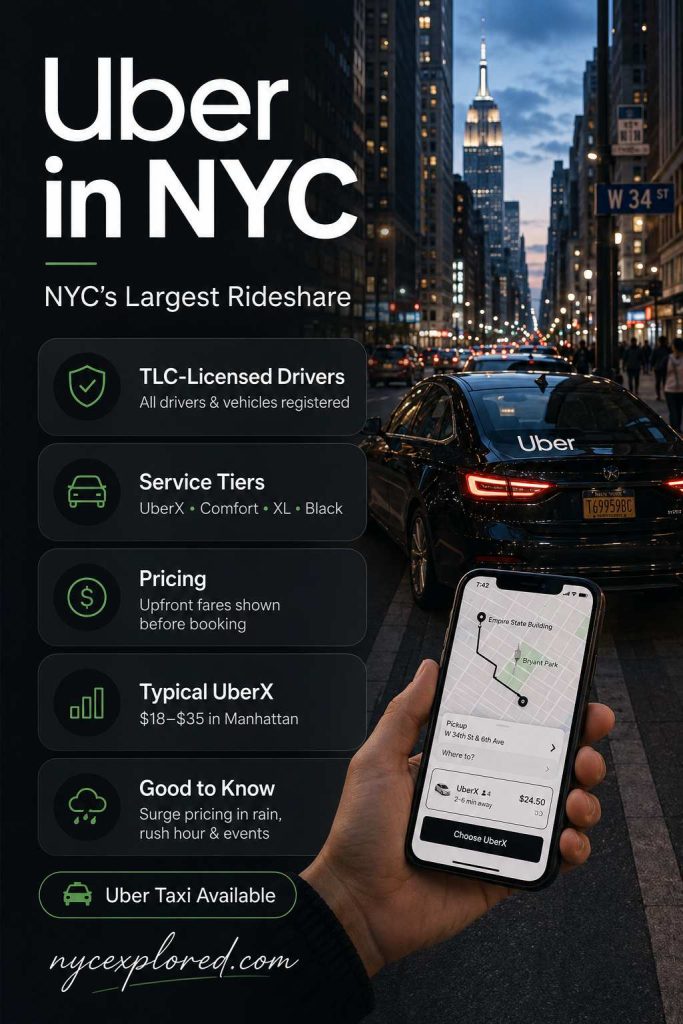
Uber launched in NYC in 2011 and is now the largest rideshare service in the city. All Uber drivers are TLC-licensed and their vehicles are TLC-registered as for-hire vehicles.
Uber Service Tiers in NYC
- UberX: Standard sedan, cheapest option, 1–4 passengers.
- UberX Share (formerly Uber Pool): Shared ride with other passengers going a similar direction. Cheaper than UberX but longer trips.
- Uber Comfort: Newer vehicles, more legroom, top-rated drivers. $2–5 more than UberX.
- UberXL: SUVs / larger vehicles, up to 6 passengers.
- Uber Black: Premium black car, professional drivers, higher fare (usually $40+ minimum).
- Uber Green: Hybrid or EV vehicles.
- Uber WAV: Wheelchair-accessible vehicle option. Very limited availability, longer wait times.
- Uber Taxi: Yes, Uber now e-hails NYC yellow taxis in some areas. Answers “can NYC taxis do Uber” — the answer is yes, through Uber’s yellow-taxi partnership.
Uber Pricing in NYC
Uber uses upfront pricing — you see the total fare before you book. Prices are dynamic: surge pricing kicks in during rush hour, bad weather, and major events. The typical Manhattan UberX ride is $18–35 base fare with tolls and tips added. Surge multipliers can push that to $50–80+ on Friday nights or during rain.
Every Uber ride in Manhattan below 96th Street has a $0.75 NY State surcharge added; below 60th Street, an additional $1.50 MTA Congestion Relief Zone toll (higher than the taxi’s $0.75). This is why Uber is proportionally more affected by congestion pricing than yellow taxis in central Manhattan.
Uber accepts credit cards, Uber Cash, PayPal, and Apple Pay/Google Pay through the app. Standard tip prompts: 15%, 20%, 25%, custom.
Lyft in NYC
Lyft is the second-largest rideshare in NYC. Same TLC license requirements as Uber. Same congestion surcharges. Slightly smaller driver base, which sometimes means longer wait times in the outer boroughs but occasionally slightly cheaper fares.
Lyft Service Tiers in NYC
- Lyft (Standard): Sedan, 1–4 passengers.
- Lyft Shared: Shared ride option, cheaper.
- Lyft XL: Up to 6 passengers.
- Lyft Lux: Premium black car.
- Lyft Lux Black XL: SUV premium.
Lyft vs Uber Cost Comparison
For a typical central Manhattan trip, Lyft and Uber usually price within $1–3 of each other. On any given ride, either could be cheaper. Serious rideshare users check both apps and pick the lower one. This is why the answer to “NYC cab vs Lyft” is usually “check the app.”
Payment is credit card or Apple/Google Pay. Standard tip options: 15%, 20%, 25%.
Curb: The E-Hail App for Yellow and Green Taxis
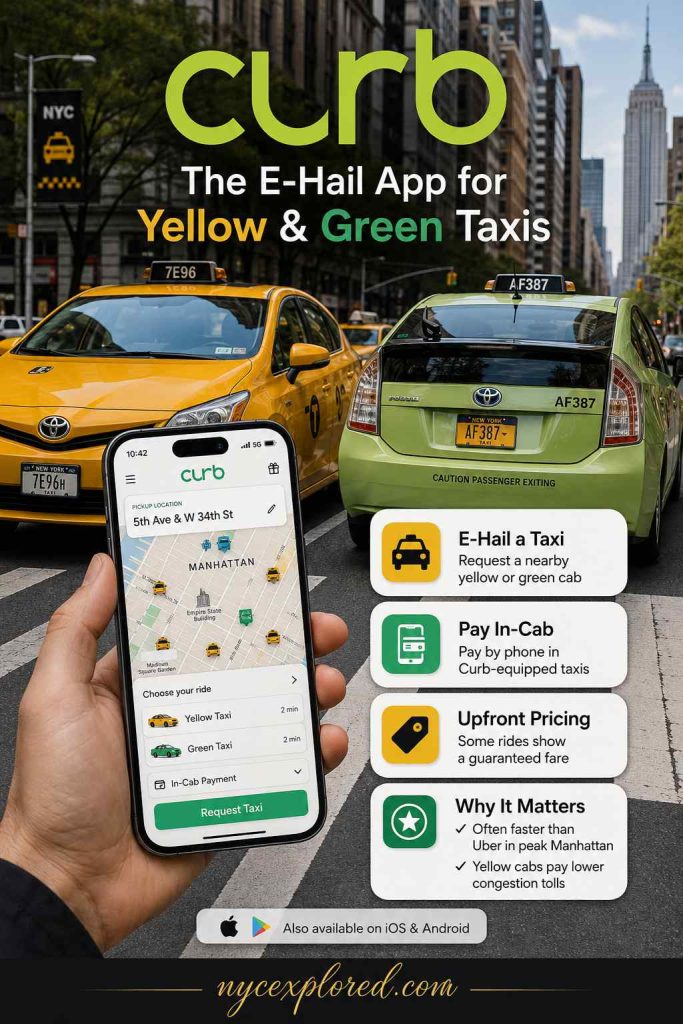
Curb is the answer to “is there a taxi app for NYC” — yes, and it’s specifically for TLC-licensed yellow and green taxis. Uber and Lyft partner with rideshare drivers; Curb partners with actual NYC taxi drivers. Available on iOS and Android.
Curb has three main functions:
- E-hail a taxi. Request a nearby yellow or green cab to come to you, no street hail needed.
- Pay in-cab via app. If you flagged a yellow taxi off the street and it has Curb technology, you can pay through your phone (skip the touchscreen).
- Upfront pricing option. Some Curb rides now offer upfront pricing (the fare is guaranteed before the trip starts).
Curb is legitimate. In peak Manhattan hours, it’s often faster than Uber because it uses existing cruising taxis rather than dispatching a specific driver. And because you’re getting a regular metered yellow cab, you avoid the $1.50 MTA congestion toll that Ubers pay (yellow cabs pay $0.75).
The competitor apps in this space — Arro and Gett — still exist but have smaller market share than Curb.
NYC Taxi vs Uber: Cost Comparison
The most common NYC rideshare & taxi question: NYC taxi or Uber?
The honest 2026 answer: Yellow cab is usually cheaper for trips under 30 minutes in Manhattan below 60th Street. Uber wins for outer-borough trips, longer routes, and any trip where you’re comparing against surge-priced yellow taxi peak-time surcharges. And yellow cab flat-rate JFK is unbeatable.
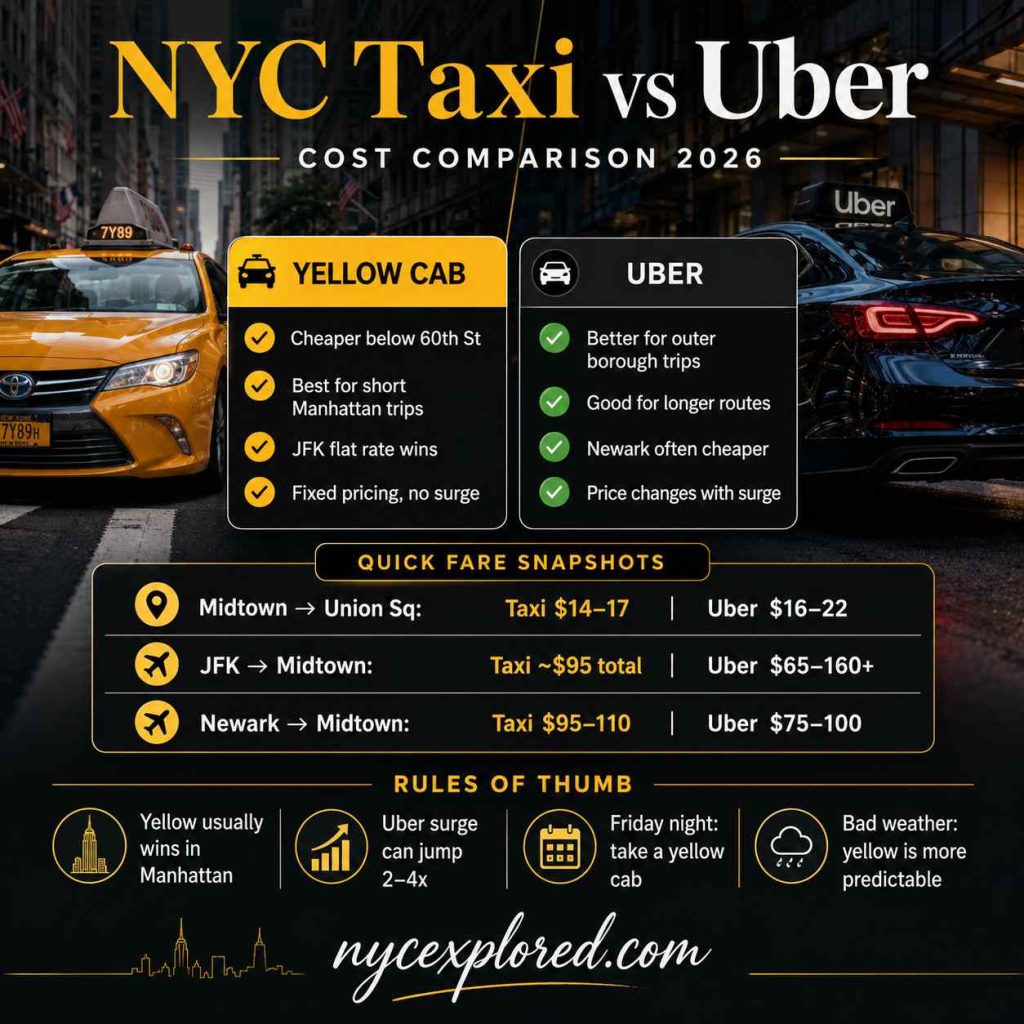
Sample Fare Comparisons (typical, no surge)
| Trip | Yellow Cab (approx) | Uber (typical) | Uber (with surge 1.8x) |
| Midtown to Union Square (2 miles, 15 min at 3pm) | $14–17 | $16–22 | $30–40 |
| Times Square to East Village (4 miles, 25 min at 5:30pm rush) | $25–30 | $28–35 | $55–65 |
| JFK to Midtown Manhattan | $70 flat + tolls + tip = ~$95 | $65–85 no surge, $110–160 with surge | $130+ |
| LaGuardia to Midtown | $40–55 metered + tolls | $40–65 | $75–95 |
| Newark to Midtown | $85–110 metered + $20 surcharge + tolls | $75–100 (usually cheaper) | $130+ |
| Brooklyn to Manhattan (Williamsburg to Midtown) | $30–45 (if cab available) | $30–40 | $55–75 |
| Manhattan to Astoria, Queens | $35–50 | $28–40 | $55–70 |
Rules of Thumb
- Below 60th Street, non-surge, weekday afternoon: Yellow cab wins.
- Weekday rush hour (4–8pm): Both charge premiums. Yellow adds $2.50 flat; Uber can surge 2–3x. Yellow usually wins here.
- Friday/Saturday night 10pm–4am: Uber surge is severe (2–4x). Yellow cab overnight adds only $1. Yellow wins by a wide margin.
- JFK to/from Manhattan: Yellow flat rate is guaranteed. Uber can range $65–160+. Yellow wins unless you specifically need Uber’s app tracking.
- Newark to Manhattan: Uber usually cheaper (~$75–100 vs $95–110 for yellow with surcharge).
- Outer-borough trips (Brooklyn, Queens, Bronx): Uber or Lyft usually cheaper because you can rarely find an available yellow cab, and green cabs may not be cruising your specific area.
- Bad weather or major events: Uber surge is dramatic. Yellow rates are fixed. Yellow wins.
The consistent answer to “NYC cab vs Uber cheaper” is: yellow cab is more predictable, Uber is more variable. When Uber isn’t surging, they’re close. When Uber is surging, yellow cab is much cheaper.
Congestion Pricing and Surcharges in 2026
NYC has three overlapping congestion-related charges as of 2026. This is the messiest part of NYC taxi and rideshare pricing.
1. NY State Congestion Surcharge (2018)
Applies to any taxi or rideshare trip that begins, ends, or passes through Manhattan south of 96th Street:
- Yellow cab: $2.50
- Green cab: $2.75
- Uber / Lyft / rideshare: $2.75 (single) or $0.75 (shared ride)
2. MTA Congestion Relief Zone Toll (January 5, 2025)
The newer per-trip charge for taxis and for-hire vehicles for trips into, out of, within, or through the Congestion Relief Zone (Manhattan south of and including 60th Street, with limited highway exemptions):
- Yellow and green taxis: $0.75 per trip
- Black cars, Uber, Lyft, rideshare: $1.50 per trip
3. Various Airport Access Fees
- JFK, LaGuardia, Newark all have separate access fees for rideshare pickup zones (Uber and Lyft absorb these into fare quotes).
- Passenger pays all tolls (Verrazzano, Cross Bay, Marine Parkway, tunnels, bridges into NJ).
Total Impact
For a Midtown-to-Village yellow cab ride at 6pm on a Wednesday, you’re paying the meter plus $2.50 rush hour + $2.50 NY State surcharge + $0.75 MTA toll + $0.30 improvement + $0.50 MTA state surcharge = $6.55 in stacked fees on top of the meter fare and any tip.
For the same trip in an Uber: upfront fare (which absorbs $2.75 NY State surcharge + $1.50 MTA toll + rush-hour surge premium).
Congestion pricing has genuinely worked in reducing gridlock — the MTA reports traffic in the Congestion Relief Zone is down 10–14% since implementation. But the fees add up on your NYC taxi and rideshare receipt.
Airport Rides: JFK, LaGuardia, Newark
Airport trips are one of the highest-stakes NYC rideshare & taxi decisions.
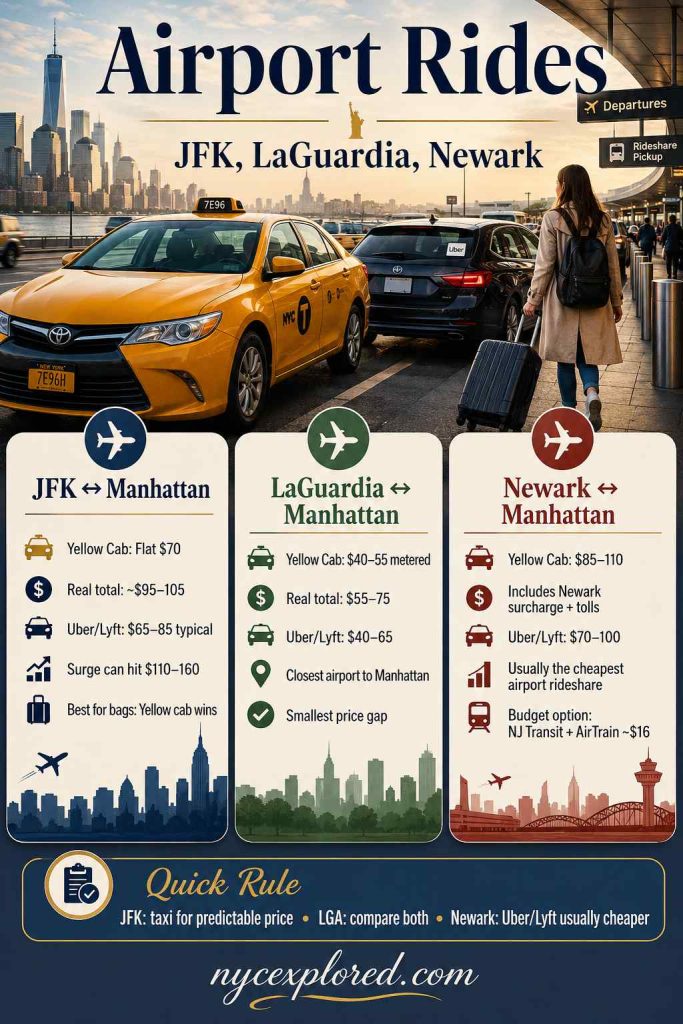
JFK ↔ Manhattan
- Yellow cab: Flat rate $70 in either direction, plus tolls (typically $10–15), tips (15–20%), and $2.50 congestion surcharge (if the trip crosses below 96th Street). Real total: ~$95–105. This is by far the most predictable JFK-Manhattan option. See the official JFK Airport taxi information for pickup zone details.
- Uber: Typically $65–85 with no surge, but surge is common. Peak times routinely hit $110–160. Adds the $1.50 MTA congestion toll and $2.75 NY State surcharge.
- Lyft: Same as Uber generally, sometimes $2–5 cheaper.
- Where to catch a yellow cab at JFK: Follow signs to the “Taxi” queue at any terminal. Free-standing dispatchers direct you to the next available cab. The queue moves quickly — usually 5–15 minutes.
- Where to catch Uber/Lyft at JFK: Follow signs to “App Pickup” zones — Terminal 4 has one on the arrivals level; other terminals have designated zones. Confirm your pickup zone in the app.
Julia’s note: For JFK to Manhattan with more than one bag or after a long flight, yellow cab flat rate wins. Guaranteed price, no surge risk, no fumbling with an app while you’re jet-lagged.
LaGuardia (LGA) ↔ Manhattan
- Yellow cab: Metered — no flat rate. Typical cost to Midtown: $40–55 plus tolls and tip. Real total: $55–75. See LaGuardia Airport taxi information for the current pickup zones.
- Uber / Lyft: $40–65 typical; can surge higher. LGA is the closest airport, so the cost gap between yellow and Uber is smallest here.
- LGA taxi queue: At each terminal’s ground transportation level.
- LGA rideshare pickup: Uber and Lyft pickup zones are at each terminal — check the app.
Newark (EWR) ↔ Manhattan
- Yellow cab: Metered fare plus $20 Newark surcharge, plus tolls (both directions — passenger pays driver’s return tolls). Typical: $85–110. See Newark Liberty International Airport ground transportation for details.
- Uber / Lyft: Usually the cheapest option — $70–100 typical, sometimes higher with surge. Uber and Lyft to Newark rarely surge as high as JFK because there’s more supply.
- Newark alternative: NJ Transit from Penn Station to Newark Airport Station + AirTrain = ~$16. Massive savings if you have time and moderate luggage.
When Yellow Cab Beats Uber (and Vice Versa)
Distilled from thousands of NYC rideshare & taxi rides:
Take a Yellow Cab When:
- You’re in central Manhattan (below 60th, especially during business hours)
- It’s raining or snowing (Uber surge multiplies dramatically)
- It’s a Friday or Saturday night
- You’re going to or from JFK Airport
- You have a group of 3–4 with light luggage
- You want a predictable fare
- Rush hour (4–8pm weekdays) — the yellow cab surcharge is fixed at $2.50; Uber surge can 2–3x
- You need one immediately and there are cabs cruising (the wait for Uber can be 5–15 minutes)
Take Uber or Lyft When:
- You’re in an outer borough (Brooklyn, Queens, the Bronx) where cabs don’t cruise
- You need a specific vehicle type (XL for 6 passengers, WAV for wheelchair access)
- You need to track your driver in real time (traveling alone at night, for accountability)
- You want upfront pricing (no meter anxiety)
- You’re going to Newark
- You’re going to or from LGA off-peak
- The trip is under $15 and you want to skip the surcharge stacking
Take Curb When:
- You want a real yellow cab but you don’t want to street-hail
- You want to pay via app in a cab you already flagged
- You’re in Manhattan and prefer taxi prices to Uber’s surge
Safety on NYC Taxi & Rideshare
Is it safe to take a taxi in NYC? Yes, generally. TLC-licensed yellow cabs, green cabs, and TLC-registered Uber and Lyft drivers all pass background checks, vehicle inspections, and driver certification. Serious safety incidents happen but are rare.

Practical safety notes:
- Confirm the driver and vehicle in Uber/Lyft before entering — license plate and car model displayed in the app.
- Share your trip through the app’s built-in trip-sharing feature. Uber and Lyft both let you send live trip info to contacts.
- Sit in the back seat if traveling alone.
- Keep credit cards, phones, and wallets in interior pockets, not on the seat.
- If you feel unsafe, ask to be dropped at a well-lit public place (a hotel entrance, a store) rather than an empty street.
- File complaints through 311 (for TLC-licensed drivers) or through the Uber/Lyft app.
- Taxicab Passenger Bill of Rights — every yellow cab is required to display it, which includes your right to a safe, courteous, English-speaking driver, a working meter, air conditioning/heating, and a smoke- and scent-free interior.
Statistically, NYC taxi and rideshare rides are safer than driving your own car in the city and safer than late-night walking in most neighborhoods. But standard urban awareness matters.
Tipping and Etiquette
- Standard tip: 15–20% for good service. 20% for airport rides. 25% for exceptional service (long wait, extra luggage, holiday).
- You can decline to tip for poor service. It’s not standard, but it’s your right per the Taxicab Passenger Bill of Rights.
- Give intersections, not addresses. Locals say “Broadway and 42nd” not “1500 Broadway.” Cabbies know the intersections better and there’s less ambiguity.
- Get in and out quickly. Don’t stand at the curb loading things for 90 seconds. NYC traffic moves.
- Direct the driver if you know a better route. Cabbies rarely take offense at “take the FDR” or “let’s stick to Broadway.”
- Don’t slam the door.
Payment on NYC Taxi and Rideshare
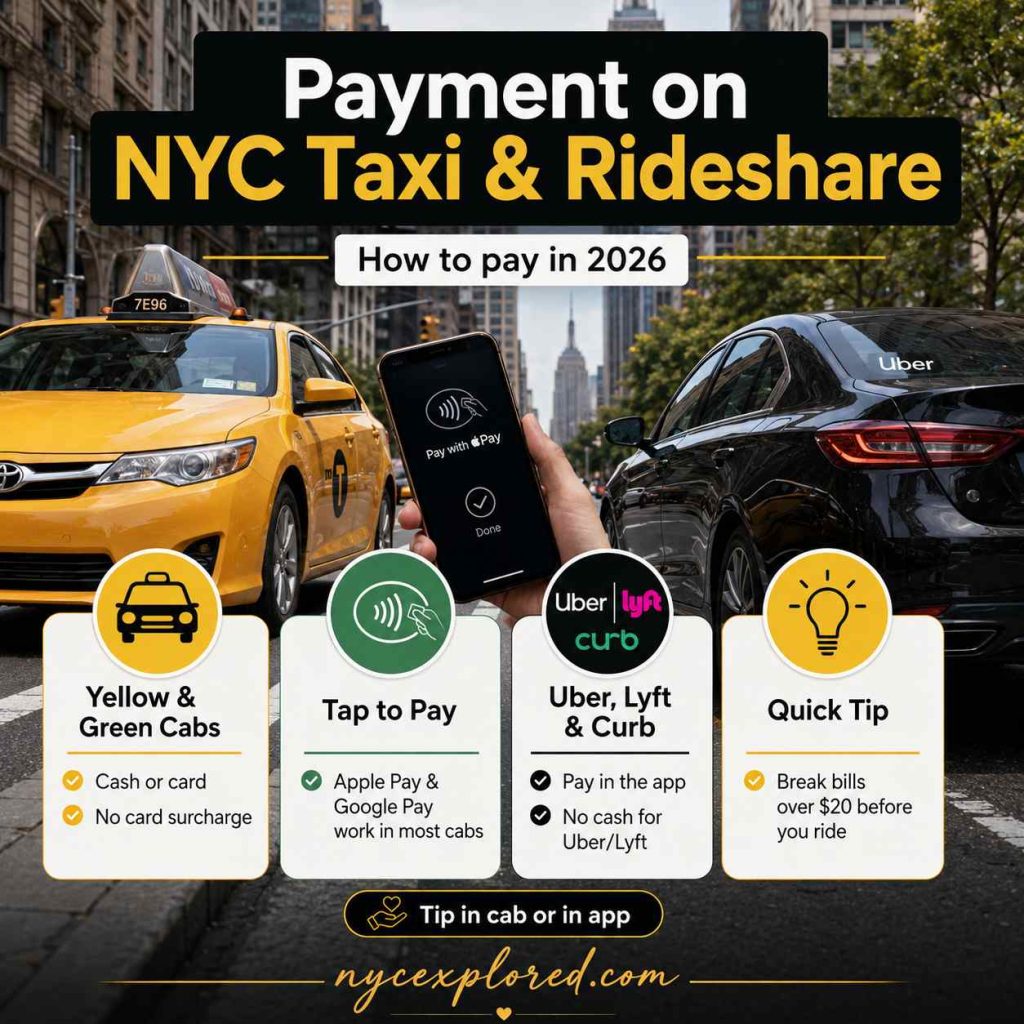
- Yellow and green cabs: Cash or credit card. All TLC-licensed cabs must accept credit cards with no surcharge. There’s a touchscreen in the back seat for payment — enter tip amount, tap card or use contactless. Apple Pay and Google Pay work in most cabs.
- Uber and Lyft: Credit card, Apple Pay, Google Pay, PayPal (through the app). No cash. Tip via the app after the trip.
- Curb: Charges your saved payment method in the app.
- Bills over $20: Yellow cab drivers are not required to accept them. Break big bills before you get in.
Accessibility: Wheelchair-Accessible NYC Taxi & Rideshare
Accessibility remains an area where NYC taxi and rideshare falls short. Options:
- Accessible yellow taxis: Roughly 50% of the yellow cab fleet is now wheelchair-accessible (WAV) as part of a TLC mandate. Look for the wheelchair symbol on the taxi’s roof light or side.
- Accessible dispatch: Call 311 or use the Accessible Dispatch NYC app to request a wheelchair-accessible taxi. No extra charge for the ride, though tips are appreciated.
- Uber WAV: Uber’s wheelchair-accessible option. Availability is limited and wait times can be significant.
- Lyft Access: Similar concept, similar limitations.
- Every MTA bus is 100% accessible — sometimes faster than waiting for an accessible taxi.
The Whisper Corners: NYC Taxi & Rideshare Local Moves
These are the tactics longtime New Yorkers use for their NYC taxi and rideshare decisions. Real moves, not marketing.
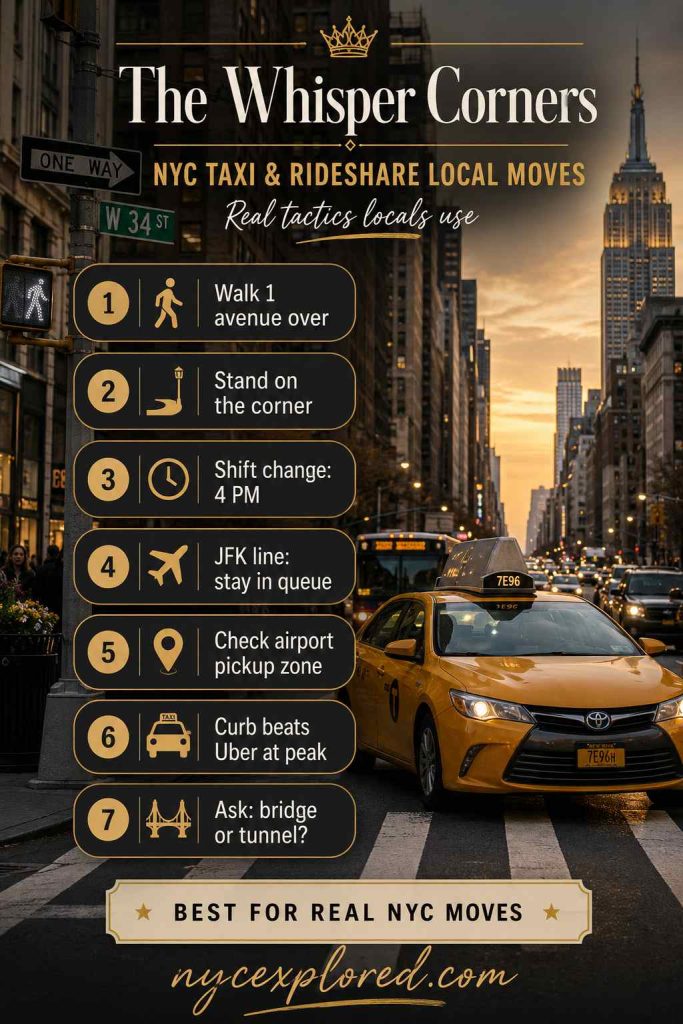
Walk One Avenue West or East
Cab availability is dramatically different on parallel avenues. If you can’t find a cab on Third Avenue at rush hour, walk two blocks to Second (going downtown) or two blocks to Lexington (going uptown). Uptown and downtown avenues in Manhattan carry different traffic — you’ll find cabs on the direction of travel.
The Corner Rule
If you’re catching a cab in Midtown at rush hour, stand at the corner (not mid-block). Corners let cabs pull over legally without blocking a bus lane, and drivers actively look for corner-hailers.
Shift Change is 4pm
Yellow cab drivers switch shifts around 4pm daily. Cabs with “off duty” lights aren’t rejecting you personally — they’re heading to their garage to hand off to the next driver. Walk a few blocks and try again 20 minutes later; fresh cabs come out.
JFK Yellow Cab Line Trick
At JFK, the yellow cab queue is usually 5–15 minutes. Don’t wander to other terminals looking for shorter lines — dispatchers rotate cabs. Just get in the queue.
Rideshare Airport Zones Change
Uber and Lyft pickup zones at JFK and LGA move periodically. Confirm the current pickup zone in the app before you head to arrivals.
Curb Beats Uber at Peak Times
During Friday 5–7pm rush, Curb can find you a yellow cab in 2–5 minutes while Uber is showing 15-minute waits and 2x surge. Try Curb first.
The Bridge/Tunnel Question
If you’re going from Manhattan to Brooklyn, ask the driver “bridge or tunnel” if it’s rush hour. The Manhattan Bridge and Williamsburg Bridge are free; the Battery Tunnel has tolls. Drivers appreciate the input.
A Final Word From Someone Who’s Taken Thousands of Rides
NYC taxi and rideshare in 2026 is a genuinely competitive market. Yellow cabs have adapted to survive rideshare — they’re now on Curb, they’re on Uber Taxi, they take contactless payment, half the fleet is wheelchair-accessible. Uber and Lyft are ubiquitous. Green cabs quietly serve the outer boroughs. Congestion pricing has added complexity but the traffic has actually improved.
My honest picks after thousands of rides:
- Central Manhattan, weekday afternoon: Yellow cab hailed off the street. Faster than any app.
- Central Manhattan, Friday/Saturday night: Yellow cab or Curb. Uber surge is punishing.
- JFK to Midtown: Yellow cab flat rate. Guaranteed price, no surge risk.
- LGA to Midtown: Uber or Lyft off-peak; yellow cab if it’s raining.
- Newark to Manhattan: NJ Transit + AirTrain if I have time; Uber if I don’t.
- Outer-borough trip (Williamsburg to Astoria): Uber, comparing to Lyft first.
- Late night alone: Uber or Lyft — the app-tracking is worth the surge premium.
The best NYC taxi and rideshare strategy isn’t loyalty to one option. It’s knowing which one wins for the specific trip you’re taking. Yellow cabs, Uber, Lyft, and Curb all serve different situations well. Download all three apps, know how to street-hail, and pick the right tool for the ride.
One last thing: New York taxi drivers have driven this city through decades of change — the 70s crisis, the 90s cleanup, the medallion crash of 2015–2019, congestion pricing, and every technological wave in between. When you take a yellow cab, you’re supporting the last mass-market owner-operated small business in Manhattan. That’s not sentimental; it’s true. Tip 20%.